The Web of Wonder: How Your Child's Curiosity Actually Works

Young children's curiosity often works through connections: one discovery sparks another question, which leads to another topic and helps them gradually build a broader understanding of the world.
As adults, we think in straight lines. But a child's mind works like a beautiful, branching web. A quiet moment learning about koalas might trigger a thought about Australia, which naturally flows into a discovery about the Great Barrier Reef, and suddenly, they are deep into learning why the ocean is blue.
Connecting the Dots
At Wikids, we do not just provide facts; we build bridges. Our platform mirrors the natural, associative way children think. Instead of a rigid "A to Z" curriculum, we empower your child to pull on any thread that excites them. When they navigate these connections independently, they are not just "jumping around," they are building a mental map of the world.
This independence turns a simple fact into a Journey of Discovery, where they are the captains of their own ship.
Start the Journey Today
Want to see the web in action? Encourage your little explorer to start today. Watch how Wikids invites them to leap to Australia, and see where their curiosity takes them next. By the time they reach the stars, they will not just know more, they will feel more capable than ever to explore the world on their own.
Guided by Connections, Not by Open Conversation
The "web" a child explores in Wikids is made of curated connections between topics, not an open AI conversation or a web search. That distinction matters for safety: a child following one discovery to the next inside Wikids can never land on an outside website, an ad, or an unrelated result. The associative jump from koalas to Australia to the Great Barrier Reef stays entirely inside a closed, age-appropriate space.
Frequently Asked Questions
How does curiosity work in young children?
Young children often explore through connections rather than in a straight line. One discovery can spark a new question, which leads to another topic and another idea. This natural curiosity helps children connect new information with things they already know and gradually build a broader understanding of the world around them.
Why does one discovery often lead children to another?
Children naturally make associations between things they see, hear, and already know. Learning about a koala might spark curiosity about Australia, which could lead to oceans, coral reefs, or other animals. Following these connections allows children to explore according to what genuinely interests them.
Why is it important to let children follow their own curiosity?
When children can choose what to explore next, they take a more active role in discovery. Instead of simply following a predetermined path, they ask their own questions, make connections between ideas, and decide where their curiosity takes them next.
How can parents encourage curiosity in preschoolers?
Follow your child's interests instead of always directing the learning. When something catches their attention, ask questions like “What else would you like to know?” or “Where do you think this could lead us?” Giving children space to follow an idea can turn one small discovery into a much bigger exploration.
Does curiosity help children learn?
Curiosity can encourage children to pay attention, explore, ask questions, and engage actively with new information. When children are genuinely interested in discovering what comes next, learning becomes part of the exploration rather than simply something they are asked to do.
How does Wikids let children follow their curiosity?
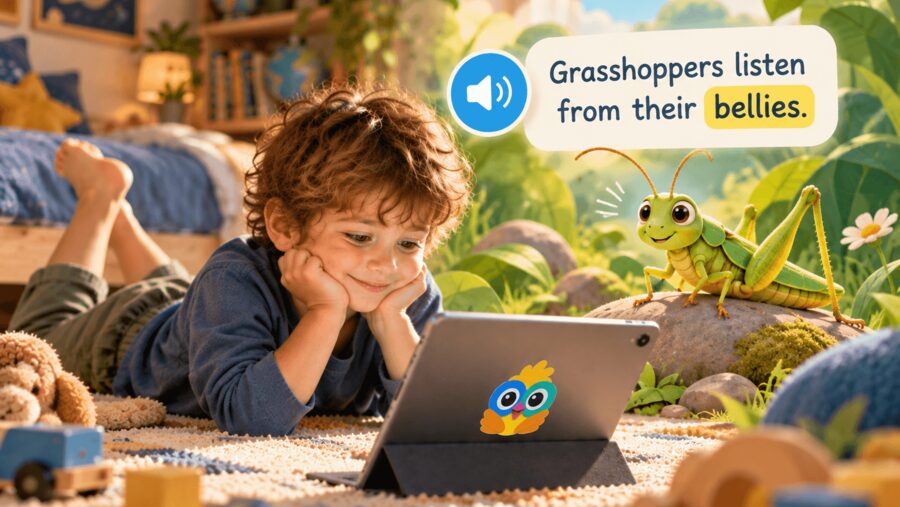
Wikids connects narrated, visual topics so children can move independently from one discovery to another based on what interests them. Instead of following a fixed learning path, pre-readers can explore different subjects and let their own curiosity decide where they go next.
Can my child end up on an unrelated or inappropriate website while exploring Wikids?
No. Wikids has no external links and no open web access. Every connection between topics stays inside the curated Wikids world.
Is Wikids' exploration powered by an AI chat conversation?
No. Wikids uses curated, narrated entries connected to one another, not a conversational AI interface. Children explore by choosing topics, not by chatting with an assistant.